
- Business Analytics
- Sep 27, 2026
Loading...


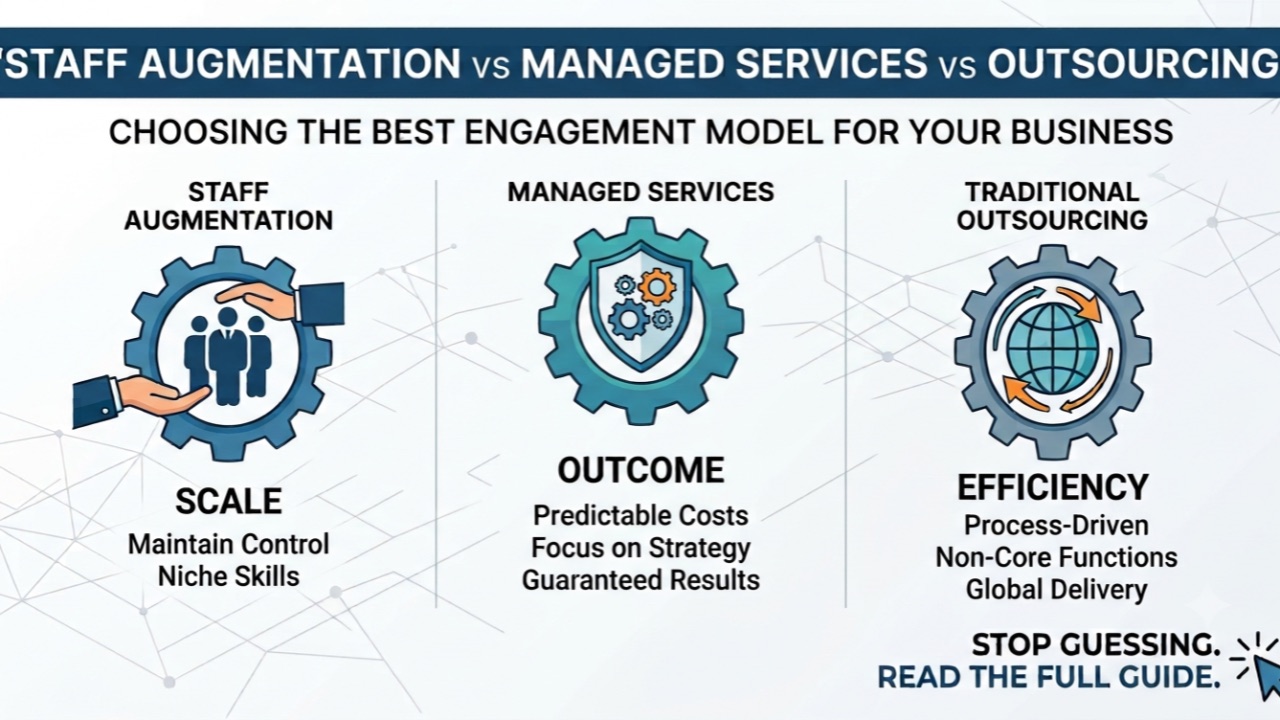
Between constant tech shifts, team expansion pushes, and the perpetual shortage of specialized tech talent, deciding how to build a team isn't as simple as posting a job ad anymore. Most companies can't afford to wait months for standard hiring channels to yield results. Instead, leadership teams are leaning heavily on agile workforce setups to bring in specific skills fast without inflating their payroll.
The three main ways to do this are staff augmentation, managed services, and traditional outsourcing. People often mix these terms up, but they handle daily operations, management, and risk in completely different ways. Picking the wrong setup usually means overpaying, hitting project delays, or burning out your internal managers.
The best choice depends on what you're trying to build, how complex the work is, and how much hands-on control you want to keep. Here is a practical look at how these models stack up, where each one fits, and how partners like ResoBridge help companies figure out the right mix.
Finding niche technical talent through normal HR recruiting has gotten brutal. At the same time, business priorities shift fast. A company might need seasoned hands for a six-month cloud overhaul, a quick AI pilot, or an intense regulatory sprint - roles that don't necessarily make sense as permanent full-time positions.
If you default to hiring full-time resource for short-term needs, you end up with high recruiting costs, long onboarding ramps, and a rigid payroll structure once the initial project wraps up. Because of that, executives are shifting their line of questioning from "Who should we bring on permanently?" to "What setup gives us access to this exact skillset today?"
With resource augmentation, you temporarily bring outside experts directly into your existing team structure. Your internal managers still run the show, assign tasks, set priorities, and evaluate the final output.
Unlike traditional vendor relationships where you hand over a project and wait for results, augmented team members work side-by-side with your full-time staff. The partner simply sources and vets the talent; you direct their day-to-day focus.
This model is huge across tech firms, consulting groups, healthcare organizations, and Global Capability Centers (GCCs) that need specialized hands on deck without taking on long-term employment obligations. Call it team scaling, resource augmentation, or staff aug - the end goal is the same: scale capability fast without losing the steering wheel.
When your project deadlines are bearing down and your core team is already stretched thin, deciding how to bring in extra capacity isn't a simple decision. Traditional hiring takes forever, headhunters charge an arm and a leg, and bringing on permanent full-time employees for a six-month push leaves you overstaffed down the road.
That is why so many leadership teams look outside their four walls for help. The three ways people usually go about this are resource augmentation, managed services, and traditional outsourcing.
While folks tend to lump these together, they operate under entirely different rules. Pick the wrong one, and you end up wasting budget, micromanaging vendors, or missing critical launch dates.
Choosing the right path comes down to three things: what you are building, who you have on staff to manage it, and how much control you need to hold onto.
Think of staff augmentation as dropping experienced contractors straight into your existing software teams, ops meetings, and Slack channels. They take assignments from your managers, use your internal tools, and build according to your exact specs. The talent partner just handles the recruiting, background checks, and payroll on their end.
It gives you direct access to specialists who would take six months to recruit through standard HR channels. You get to adjust team size as work ramps up or winds down, and you skip the long-term baggage of equity, health benefits, and severance risks.
Staff augmentation shines when you already have strong leads who know how to manage a project, but you lack specific technical muscles or simply need more hands on deck to hit a date.
When Pfizer scrambled to distribute its COVID-19 vaccine across the globe, the sheer volume of work in supply chain planning, regulatory filings, and market forecasting was overwhelming.
Hiring hundreds of permanent staff through HR would have taken far too long. Pfizer brought in specialized contractors, CROs, and consulting teams to boost capacity overnight. Pfizer’s internal directors stayed in total control of the strategy and intellectual property, while the contractors took care of heavy analytical execution.
Why it mattered: They got the speed and massive scale they needed without doubling their core headcount forever.
You get people working on real tasks in days rather than months. Because you manage them directly, you see what gets built every single day. If project priorities shift mid-stream, you can redirect your augmented staff immediately without renegotiating a master vendor contract.
Augmentation puts the management load on your shoulders. You have to set aside internal lead time to assign tickets, review code or deliverables, answer questions, and get contractors onboarded.
If your internal managers are already working 60-hour weeks and don't have time to direct extra people, staff augmentation will choke. In that scenario, a managed service is a much safer move.
At ResoBridge, we skip the resume-dump routine. We look at the actual problem you're trying to solve and match you with people who have already done that exact job in your industry.
Whether you need AI talent, healthcare domain leads, or supply chain engineers, we get proven experts into your workflows quickly - giving you the speed you need while keeping you in total command of the output.
Managed services isn't about adding extra headcount to your morning stand-up. It's about handing an entire operational function over to a vendor who agrees to run it according to strict Service-Level Agreements (SLAs).
They bring their own managers, set up their own internal processes, hire their own staff, and guarantee specific metrics - like 99.9% system uptime, 15-minute helpdesk ticket responses, or error-free monthly reporting. You don't track how many hours their individual employees work; you measure whether they met the target outcomes.
Managed services work great when you want to take routine, heavy operational work off your plate.
For instance, a hospital group that moves its infrastructure to the cloud doesn't need to burn out its internal software engineers monitoring servers at 3:00 AM. They pass 24/7 cloud monitoring, patch management, and security compliance to a managed service partner. That lets their in-house team focus on building patient-facing apps instead of triaging server logs.
You get predictable monthly costs, clear vendor accountability, and an entire team's worth of deep expertise without the hassle of hiring or managing them.
Outsourcing takes things a step further by handing off a complete business process from start to finish. The vendor owns the tools, the staff, the physical location, and the execution.
Standard examples include Tier-1 customer call centers, routine payroll processing, basic bookkeeping, and medical claims processing.
Outsourcing works when the work is predictable, highly repetitive, standardized across your industry, and doesn't represent your secret sauce. If an e-commerce store needs 24/7 coverage for simple return requests and order tracking, outsourcing that call center lowers overhead significantly.
The trade-off? You have zero direct control over daily execution, and it is a terrible choice for high-stakes strategic work that requires close team collaboration or tight IP protection.
There is no single "right" model - it comes down to what you are trying to accomplish and who you have available to lead it.
At ResoBridge, we don't start by slinging resumes at your job board. We start by looking at your current bottlenecks, your internal management capacity, your timelines, and your budget.
Whether you need two augmented engineers to clear a backlog, a dedicated delivery squad, or high-level advice on structuring your tech workforce, ResoBridge designs flexible models that fit. We build adaptive partnerships that scale seamlessly as your business priorities shift.
It's a way to hire temporary external specialists who work directly under your team's managers, while a partner agency handles their payroll, benefits, and recruiting.
With staff augmentation, your managers direct the worker's daily tasks and code. With outsourcing, you hand off the entire process to a vendor who manages the workers and delivers the final result independently.
When you have an ongoing operational task - like network monitoring, cloud maintenance, or data pipeline upkeep - that you want run reliably against strict SLAs without pulling your internal leads away from core projects.
It's widely used across healthcare, life sciences, tech, finance, engineering, and consulting - any sector where technical talent is hard to recruit quickly and project timelines move fast.
We connect you with specific specialists across AI, analytics, life sciences, procurement, and cloud tech, letting you scale capacity instantly while keeping full command over your project.
Yes. We review your project goals, internal management bandwidth, and delivery dates to recommend whether staff augmentation, managed services, or a blended model makes the most operational sense.
Yes. Whether you need specialized coverage for a four-week sprint or a year-long system overhaul, we offer flexible setups built around your schedule.
We bring real industry experience and consulting know-how together with fast access to proven talent - helping you skip hiring delays, keep overhead low, and deliver actual business results.
Planning a Power BI rollout, a business intelligence refresh or analytics staff augmentation? We are happy to look at it with you.
Talk to an Expert