Roughly 70% of digital transformation initiatives fail to meet their stated goals, according to research consistently cited by McKinsey and Boston Consulting Group.
That number hasn't moved much in over a decade, despite trillions of dollars in global technology spending. The pattern behind it isn't really about technology - it's about whether strategy, people, and data move together. This guide breaks down what separates the transformations that work from the ones that quietly fail, based on patterns across successful and failed initiatives.
Ask ten executives what "digital transformation" means, and you'll get ten different answers. Somewhere along the way, it stopped being a business conversation and turned into a technology shopping list. Companies bought tools. Most still haven't seen the return - and the data backs that up.
Why Do Digital Transformation Projects Fail? The Data
Digital transformation projects fail primarily because of unclear objectives, weak change management, and poor data quality - not because of the technology itself. Gartner research cited in industry coverage found that nearly 60% of employees are not supportive of the organizational changes their transformation programs require. Separately, data quality is now the single most cited barrier to successful transformation, with 64% of organizations naming it their top challenge.
The encouraging counterpoint: organizations that invest seriously in culture and change management - not just tooling - see roughly 5.3x higher success rates than those that treat transformation as a purely technical rollout.
In other words, the failure rate is a people-and-data problem wearing a technology costume.
- Start With the Business Problem, Not the Technology. The highest-performing transformation teams define the business problem before selecting any technology. Teams that get this right don't ask "should we use AI?" first. They ask "what's actually broken?" Technology should serve the strategy - the moment it becomes the strategy, things drift. Before any initiative gets approved, someone should be able to clearly answer: what are we fixing, and how will we know it worked?
- Leadership Ownership Beats Leadership Approval. Transformation succeeds when executives stay actively involved past the funding stage, not just at sign-off. Transformation touches nearly every part of a business, so it can't sit with IT alone. Projects stall when leadership approved the budget but isn't still in the room when things hit their first real obstacle. Real alignment means shared accountability and faster decisions - without it, every department quietly builds its own version of the same project.
- Data Quality Determines Whether Analytics Can Be Trusted. Poor data quality is the top-cited barrier to digital transformation success, reported by 64% of organizations. More data isn't the same as better data. Feed a flawed dataset into even the most advanced analytics or AI system, and the output is just confidently wrong. Before investing in AI or forecasting tools, it's worth honestly checking: is the underlying data accurate, governed, accessible, and consistent? Unglamorous work, but it's what makes dashboards trustworthy instead of ignored.
- Data Should Change a Decision, Not Just Describe the Past. Mature analytics programs move from describing what happened to prescribing what to do next. Most organizations get comfortable reporting what happened and stop there. The real value is moving toward what's likely to happen and what to do about it - spotting trends early instead of reacting after a competitor already has. More dashboards isn't the goal. Better decisions are.
- Employee Adoption Fails Without Change Management. Nearly 60% of employees are unsupportive of the changes their transformation requires when change management is weak or absent. A technically flawless rollout can still fail if employees never buy in - and that resistance usually comes from uncertainty, not stubbornness. People want to know how a change affects their actual job, and what support they'll get. Change management needs to be part of the plan from day one, not a memo the week before launch.
- Phased Rollouts Outperform Big-Bang Launches. A phased pilot-then-scale approach reduces risk compared to organization-wide rollouts. Big-bang rollouts look efficient on a slide and multiply risk in practice. A steadier path: pick one high-impact problem, pilot it, measure results, then scale. It's slower, but it tests assumptions early and builds momentum with real wins instead of one high-stakes bet.
- Legacy Systems Aren't Automatically the Enemy. The decision to replace, integrate, or retire a legacy system should be based on business impact, not system age. The right question isn't "how old is this system?" It's "is this system actually stopping us from hitting our goals?" Sometimes the answer is replace it. Just as often, it's integrate, modernize in place, or leave it alone. Let business need drive the decision, not the instinct to chase what's newest.
- Measure the Outcome, Not the Rollout. Transformation success should be measured by business KPIs - revenue, cost, retention - not by the number of systems deployed. Counting systems deployed or features shipped doesn't tell you if the business is better off. The metrics that matter are revenue, cost, retention, efficiency, forecast accuracy, and speed to market. If a transformation can't answer "what value did this create?" - it's a hard sell at budget time.
- Treat Transformation as a Habit, Not a Project. Digital transformation has no finish line - it requires continuous evaluation as markets and technology shift. Markets shift, competitors launch new models, and expectations keep changing. The organizations that hold up well keep asking: what's working, what isn't, and what should we stop doing? - instead of treating transformation as a one-time initiative with a ribbon-cutting.
- Tie Every Initiative Back to Business Strategy. Every transformation initiative should map directly to a stated business priority - growth, efficiency, experience, or innovation. If the priority is growth, transformation should serve growth. If it's efficiency, it should show up in lower costs. If it's customer experience, it should make things simpler - not add friction. Every initiative should answer one blunt question: does this actually move the business toward where it's going?
Where Business Analytics Fits Into Digital Transformation
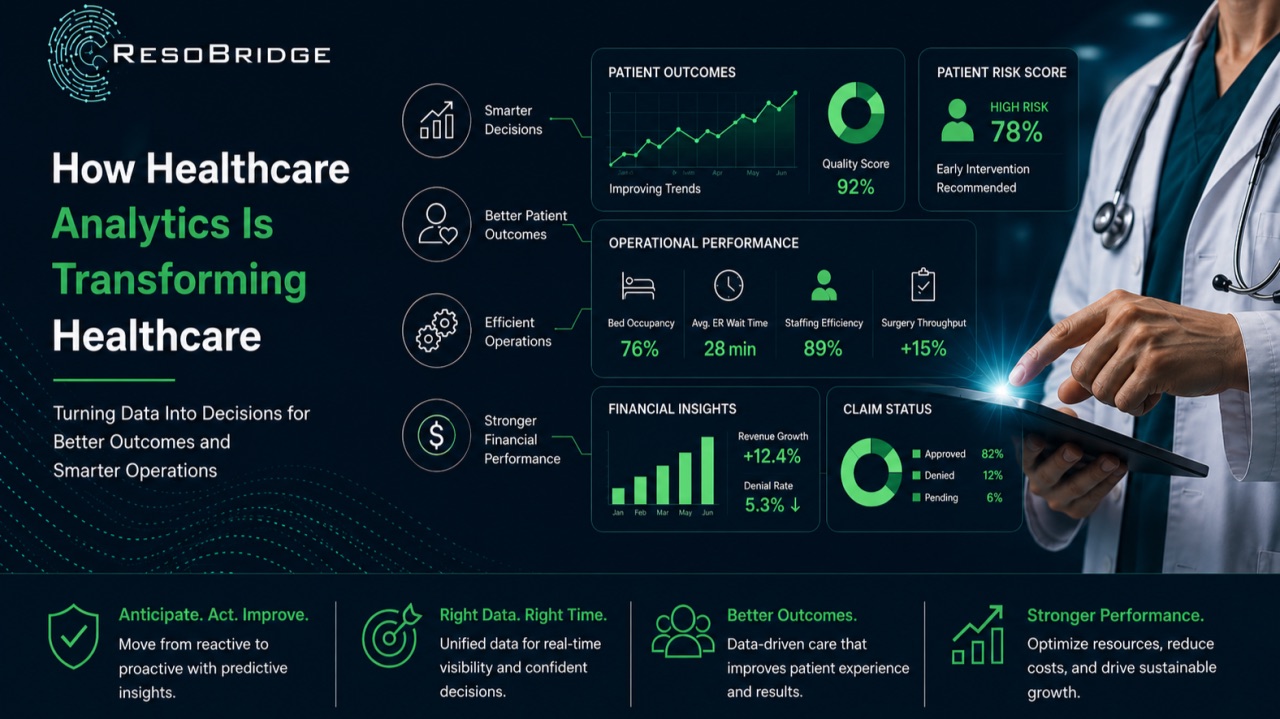
Business analytics is the mechanism that converts raw transformation data into decisions leadership can act on. Analytics turns raw data into decisions - market intelligence, customer behavior, forecasting, risk signals. Done well, it shifts a company from data → reports → decisions to data → insight → action → outcome. That shift is really what "data-driven transformation" means, and it's where firms like ResoBridge focus most of their engagement work.
A Practical Digital Transformation Framework
- Define the actual business problem.
- Set measurable success criteria upfront.
- Take an honest inventory of current tech, data, and people.
- Prioritize the highest-impact, most feasible opportunities.
- Fix the data foundation before layering on analytics.
- Turn analytics into insight people can act on.
- Build training and communication into the rollout.
- Pilot before scaling.
- Track KPIs tied to real business value.
- Revisit and adjust as conditions change.
How ResoBridge Supports Digital Transformation
Transformation isn't really a technology purchase - it's business understanding, data discipline, and execution working together. ResoBridge covers that full stack: data analytics and business intelligence, market and competitive intelligence, forecasting and predictive analytics, data science and AI/ML, data engineering, technology and DevOps, and social listening. Organizations that work with ResoBridge on digital transformation initiatives get support turning complex data and business challenges into decisions leadership can act on.
Frequently Asked Questions
Is digital transformation only for large companies?
No. The core discipline scales down to smaller organizations - only the budget and scope of change, not the underlying approach.
How should digital transformation success be measured?
Digital transformation success should be measured by business outcomes - revenue, cost savings, retention, efficiency, and forecast accuracy - not by how many systems have been implemented.
Should a company transform everything at once?
No. A phased approach - pilot, measure, then scale - consistently reduces risk compared to a single large-scale rollout.
How is digital transformation different from technology modernization?
Technology modernization upgrades systems. Digital transformation is broader - it touches process, people, data, and strategy together, not just infrastructure.