- Business Analytics
- Sep 27, 2026
Loading...


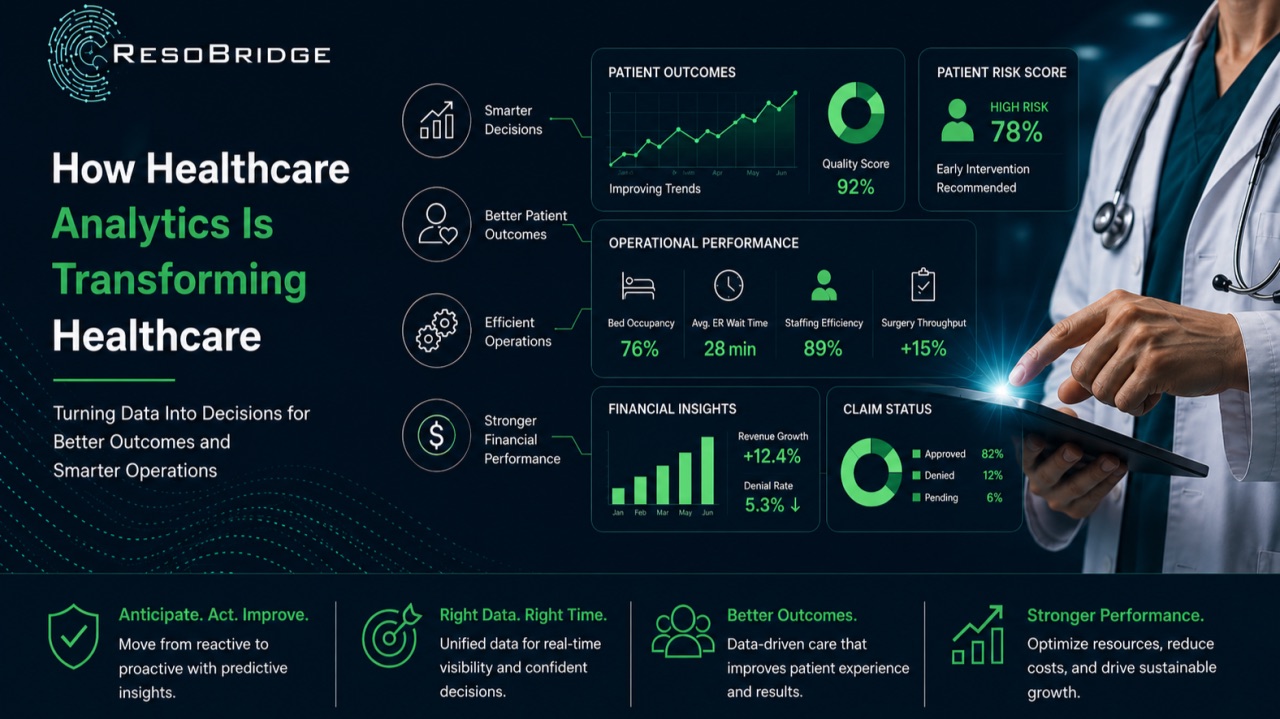
Healthcare doesn't have a data shortage. Every patient visit, diagnostic scan, prescription, billing claim, and EHR entry adds to a pool of information that's already massive and growing by the day. Healthcare organizations now generate roughly 30% of the world's data - yet by some estimates, up to 97% of that hospital data is never actually used.
In short: healthcare analytics is the practice of turning that scattered clinical, financial, and operational data into decisions - faster staffing calls, fewer denied claims, earlier warnings on patient risk, and tighter supply budgets. The organizations pulling ahead right now aren't the ones with the most data. They're the ones that turned it into something usable.
That distinction - data collected versus data used - is where healthcare analytics earns its place on every health system's roadmap in 2026.
For most health systems, information is scattered across EHRs, lab systems, billing platforms, pharmacy databases, and a long tail of specialized tools that were never built to talk to each other.
Having access to all this information doesn't automatically create better outcomes. When systems stay disconnected, healthcare teams struggle to get a complete picture of what's actually happening across the organization - a nurse manager sees staffing gaps, finance sees a revenue dip, and nobody sees that the two are connected.
Modern healthcare analytics platforms exist to close that gap. They pull fragmented sources together and turn raw records into insights teams can act on the same day, not the same quarter. Instead of only looking backward at what happened last month, organizations can use analytics - paired with big data analytics infrastructure - to spot patterns, flag problems early, forecast risk, and make informed calls in real time.
For healthcare executives, analytics has moved well past being "an IT thing." The global healthcare analytics market was valued at roughly $53-65 billion in 2025, and most major forecasts project it will more than double by 2030 as AI-driven and predictive analytics tools become standard rather than experimental.<br>
When analytics is combined with strong data infrastructure and targeted automation, organizations can start anticipating operational problems instead of constantly reacting to them. In practice, that means better resource planning, faster workflows, sharper financial visibility, and more confident clinical decisions.
At ResoBridge, we look at healthcare analytics through an operational lens. Technology only creates value when it makes daily work easier for clinical teams and gives decision-makers the visibility they need to act with confidence - not another dashboard nobody opens.
A single patient's journey creates data points across dozens of disconnected tools - EHRs, lab portals, billing software, remote monitors, pharmacy systems. Most health systems are running on fractured software stacks where departments operate like walled gardens.
When finance can't see what operations is doing, and clinicians are buried in manual documentation, leadership loses line-of-sight on the business as a whole. This fragmentation persists even though the underlying data mostly exists - it's rarely in a format decision-makers can use quickly.
To be fair, the raw infrastructure has improved a lot over the last decade. EHR adoption among U.S. hospitals jumped from 28% in 2011 to 96% by 2021, according to the Office of the National Coordinator for Health IT. The records exist now. The gap is turning those records into a connected, queryable system - which is exactly what healthcare analytics and big data analytics platforms are built to do.
Traditional reporting tells you what happened last month. Modern healthcare analytics tells you what's happening now, why it's happening, and what's likely to happen next. That shift typically plays out across four levels.
Descriptive analytics tracks core operational baselines - admissions, ER wait times, bed turnover, surgical throughput. It's still the largest segment of the healthcare analytics market by a wide margin, because every other layer depends on having this baseline right first.
Diagnostic analytics digs into the root cause behind an operational or financial problem - why readmissions spiked in one unit, or why a specific payer keeps rejecting claims. Instead of just showing that performance dropped, it explains what drove the drop.
Predictive analytics uses historical and real-time data, often paired with machine learning, to flag patterns before they turn into full-blown problems. Health systems use predictive analytics to forecast ER surges, flag high-risk chronic patients, or catch equipment failures before a critical machine goes down. This is the layer that moves a team from reactive firefighting to proactive planning - and it's also the fastest-growing segment of the healthcare analytics market right now.
Prescriptive analytics goes one step further and recommends specific actions based on the data - rebalancing OR schedules, adjusting nurse shifts, or resetting medical supply reorder points in real time. The goal was never another report. It's a decision someone can act on before their next shift starts.
Pretty dashboards don't pay the bills. Workflow fixes do. Applied directly to daily operations, healthcare analytics delivers measurable impact in a few specific, high-friction areas.
Supply chain management: Hospitals lose millions annually to misplaced, overstocked, or expired inventory. Better visibility lets procurement teams anticipate shortages, cut waste, and keep critical supplies on hand when clinicians actually need them. Big data analytics can also surface purchasing patterns that improve budget planning over time.
Revenue integrity: Diagnostic and predictive analytics catch claim errors and payer rejection patterns before they cost the organization money - not after the appeal has already failed.
Staffing and capacity: Predictive models forecast patient surges days in advance, giving managers time to adjust schedules instead of scrambling on the day of.
Security and compliance: This one cuts both ways: healthcare data breaches now cost an average of $7.42 million per incident, and organizations that lean on strong data governance and analytics maturity tend to detect and contain incidents faster than those running on fragmented systems.
You can buy the most expensive analytics platform on the market and it still won't fix a broken culture. Healthcare transformation happens when clinical leads, administrators, and finance teams work from the same reliable source of information.
When teams agree on core metrics, take data governance seriously, and build reporting into daily standups instead of quarterly reviews, efficiency gains follow - not the other way around. Analytics shouldn't live in a silo reserved for analysts or IT. It earns its value when decision-makers across the organization can actually read and use it as part of everyday work.
At ResoBridge, we don't build dashboards just to give executives more charts to scroll through. We use healthcare analytics and big data analytics as tools to strip friction out of everyday operations and turn fragmented information into decisions people actually make.
We focus on helping healthcare clients:
Data isn't an administrative byproduct you store in the cloud and forget about - it's one of the most valuable strategic assets a health system owns. Aligning your data strategy with your actual business goals is one of the most effective ways to build a resilient, high-performing organization.
Ready to see what your data could actually be doing for you? Talk to the ResoBridge team about a healthcare analytics assessment for your organization.
It's taking the messy data health systems generate - EHR entries, lab results, billing codes, patient feedback - and organizing it into something actionable. Instead of drowning in spreadsheets or waiting on quarterly reports, hospital teams use analytics to spot bottlenecks, manage costs, and keep care delivery running smoothly.
Running a hospital on gut feel or month-old summaries doesn't hold up anymore. Operating margins are thinner, staffing is tighter, and patients expect more. Real-time analytics gives leaders a clearer view of what's happening across their facilities - enough lead time to fix scheduling, billing, or capacity problems before they escalate.
Predictive analytics can flag risk earlier by analyzing incoming lab results, vital signs, and patient history for warning patterns tied to sepsis, deteriorating conditions, or likely readmissions. That earlier flag gives clinical teams more time to assess and act.
It comes down to focus versus infrastructure. Healthcare analytics is about solving specific clinical, operational, or financial problems - optimizing nurse shifts, catching revenue leakage. Big data analytics refers to the broader technology and infrastructure needed to collect, store, and process very large volumes of information. In practice, they work together: strong big data infrastructure is what makes reliable healthcare analytics possible in the first place.
It surfaces the small problems that create outsized friction - bed transfer delays in the ER, billing mistakes before a payer rejects the claim, better shift rosters, ORs that actually have the supplies they need. The goal is workflows that are more predictable and easier to manage, not more dashboards.
Usually it isn't the software - it's legacy technology, fragmented data, and inconsistent workflows underneath it. Placing a sophisticated analytics platform on top of unreliable data doesn't produce reliable results. Data quality, integration, and governance need to be addressed first.
ResoBridge connects healthcare technology to actual business operations - linking existing data sources, automating repetitive manual work, and building an analytics strategy around measurable financial, operational, and clinical goals. The focus is making data useful, not making more of it.
Planning a Power BI rollout, a business intelligence refresh or analytics staff augmentation? We are happy to look at it with you.
Talk to an Expert