- Business Analytics
- Sep 27, 2026
Loading...


Let’s be honest: AI has officially moved from the innovation lab into every single quarterly business review. Leaders across every sector are being pressured to figure out how machine learning and generative tools can sharpen decision-making, automate boring work, or spin up fresh revenue streams.
Here’s the catch - a huge chunk of these initiatives hit a brick wall.
Why? Because teams tend to start at the finish line. They race out to buy flashy AI platforms or license enterprise LLMs without taking a hard look at the foundation holding everything up: their actual data.
An algorithm is only ever as good as what you feed it. Messy data, disconnected legacy systems, fuzzy business goals, and a team that doesn't know how to interpret analytics will wreck an expensive AI budget every single time.
If you don't have a clear data analytics roadmap, you simply can't build a working AI strategy.
A real analytics roadmap gives you a practical, step-by-step game plan for turning chaotic information into something reliable before you start stacking complex automation on top. It forces an honest reality check on where your operations stand today, where you actually need to go, and how your people, tools, and workflows need to adapt to get there.
At ResoBridge, we take a zero-fluff approach to AI. It isn't about collecting shiny tech; it's about building a grounded business strategy that connects data directly to your bottom line.
Think of an AI roadmap as your operational blueprint. Instead of throwing software at the wall and praying something sticks, a proper plan forces leadership to wrestle with a few tough questions upfront:
A complete roadmap ties five moving parts together: Business Objectives ➔ Data Foundations ➔ Analytics Maturity ➔ AI Execution ➔ Governance & Scaling.
Skip those early stages, and you’ll almost certainly wind up stuck in "pilot purgatory" - a cycle of cool experiments that never actually ship or generate revenue.
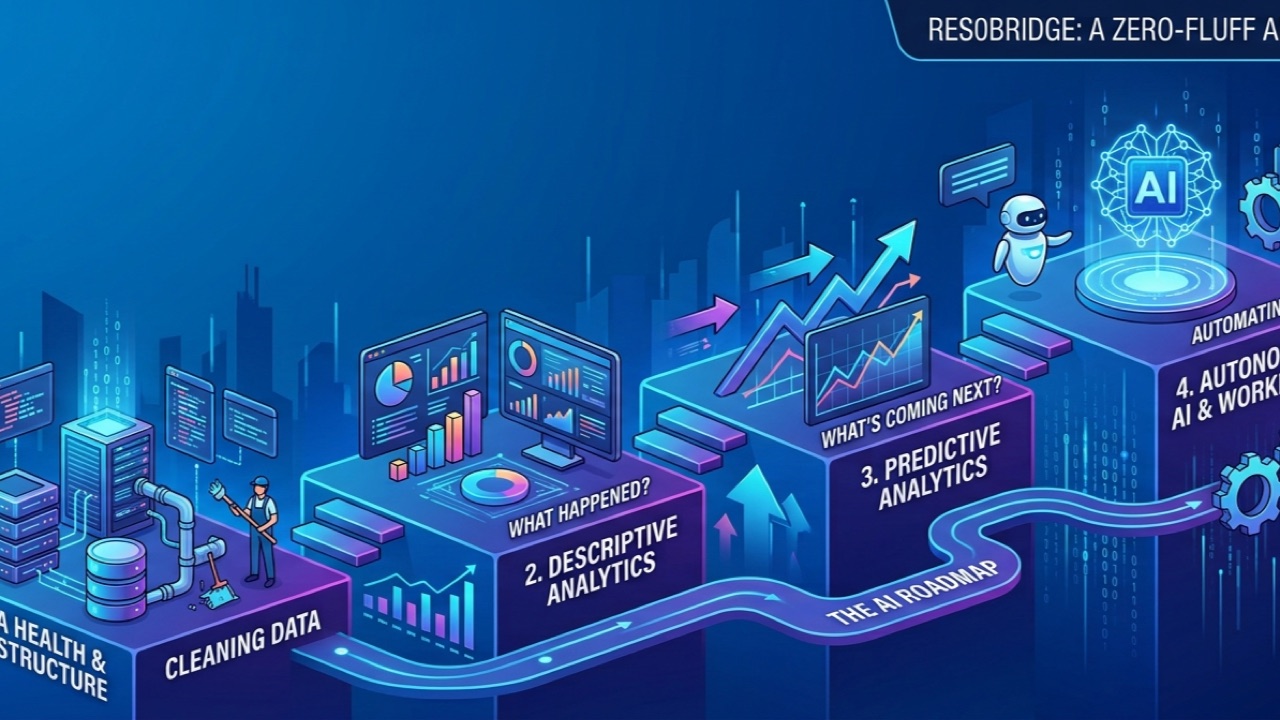
You can't jump straight to fine-tuning machine learning models if your basic weekly reporting is a mess. Moving toward AI is a staircase, not an elevator ride.
First, you need total visibility into your ecosystem. Where is your data sitting? Who owns it? Is any of it actually accurate?
Legacy organizations usually get tripped up right here. Customer history lives in a CRM, financial data is buried in an old ERP, and operational logs are scattered across individual spreadsheets. If those systems don't talk to each other, an AI engine won't stand a chance.
Once your data lives in one place, you start building real visibility. Dashboards, core BI tools, and performance tracking give you a clear look at past performance, helping you establish baseline numbers and spot broader trends.
With clean historical trends in hand, you can start looking down the road. Predictive models help you anticipate customer churn, forecast demand spikes, evaluate operational risk, and keep inventory lean. This is the exact bridge where traditional business intelligence turns into real AI.
Now you're ready for advanced tech - tailored ML models, smart assistants, and automated workflow engines. Because your underlying data pipes are clean, these systems deliver real operational wins instead of expensive hallucinations.
The quickest way to burn cash is asking, "Where can we implement generative AI this quarter?"
Flip that thinking completely. Ask: "Where are we losing time, dropping margins, or bleeding customers?"
Don't just assume your setup is ready. Evaluate your operation across four baseline areas:
Tools don't execute strategies; people do. Retraining your current staff is infinitely cheaper than trying to outbid tech giants for a whole team of elite data scientists.
You can't do everything at once. Plot every potential project on a basic matrix comparing Business Value against Technical Complexity.
Microsoft didn't scale its Copilot tools by asking workers to learn a completely new platform. They plugged AI directly into Excel, Teams, Word, and Outlook. Because it runs on top of Microsoft Graph - their unified enterprise data engine - the AI already understands the company's context out of the box.
The Lesson: AI shouldn't feel like an extra chore. It works best when built straight into existing habits.
NVIDIA didn't dominate the AI landscape just by selling fast GPUs. They built an entire hardware-and-software stack (CUDA, Omniverse, BioNeMo) that gives researchers a stable foundation.
The Lesson: Top-tier algorithms crash without serious computing power and well-architected data pipelines behind them.
Unilever uses advanced analytics to track shifting consumer habits, forecast regional inventory, and adjust local marketing on the fly. By connecting real-time market data straight into their supply chain, insights turn into immediate operational moves.
The Lesson: Data analysis is just academic exercise if it doesn't trigger immediate action on the ground.
If you’re running a pharma or life sciences business, adopting AI isn't just a technical challenge - it’s a regulatory gauntlet. Giants like Johnson & Johnson and Novartis aren't just using AI to churn out faster clinical trial data or discover new compounds; they're doing it under the relentless gaze of global compliance boards.
Every single model they deploy needs strict data governance, continuous validation, and absolute privacy safeguards.
The takeaway here is simple: in high-stakes industries, governance isn't bureaucratic fluff. It’s your insurance policy. If your data foundation isn't bulletproof, scaling AI safely becomes an impossible task.
Over the years, we’ve watched dozens of well-funded AI initiatives collapse. Almost every single failure comes down to one of four avoidable traps:
Moving from messy spreadsheets to a genuinely AI-driven company takes more than an outside tech vendor selling software. It takes a strategic partner who understands operational reality.
At ResoBridge, we help executive teams cut through the noise and turn complex, messy data setups into clear financial outcomes:
It’s a strategic plan that outlines how your organization will collect, manage, analyze, and use data to support business objectives. It helps prioritize investments, improve decision-making, and build a strong foundation for AI adoption.
While it's possible to deploy AI tools without a roadmap, organizations often struggle to achieve meaningful results due to fragmented data, poor data quality, or unclear business objectives. A structured roadmap helps ensure AI initiatives are aligned with business goals and supported by reliable data.
ResoBridge helps organizations assess data maturity, develop data analytics strategies, identify high-impact AI use cases, optimize business processes, and build practical implementation roadmaps. We also provide consulting in healthcare, life sciences, market research, business intelligence, and commercial analytics.
ResoBridge works with organizations across healthcare, pharmaceuticals, life sciences, biotechnology, medical devices, and other data-driven industries. Our consulting approach is tailored to each industry's operational, regulatory, and market requirements.
We begin by understanding your business objectives, evaluating your current data landscape, and assessing analytics maturity. Based on these insights, we prioritize AI use cases that offer the highest business value, technical feasibility, and return on investment.
For most mid-sized to enterprise organizations, a deep-dive assessment and roadmap build takes anywhere from 4 to 8 weeks - mostly depending on how tangled your existing legacy systems are.
Yes. In addition to strategy development, ResoBridge helps organizations strengthen their analytics capabilities by defining team structures, identifying skill gaps, and creating development plans that enable teams to effectively use data and AI for decision-making.
Planning a Power BI rollout, a business intelligence refresh or analytics staff augmentation? We are happy to look at it with you.
Talk to an Expert