- AI and Analytics
- Nov 25, 2026
Loading...


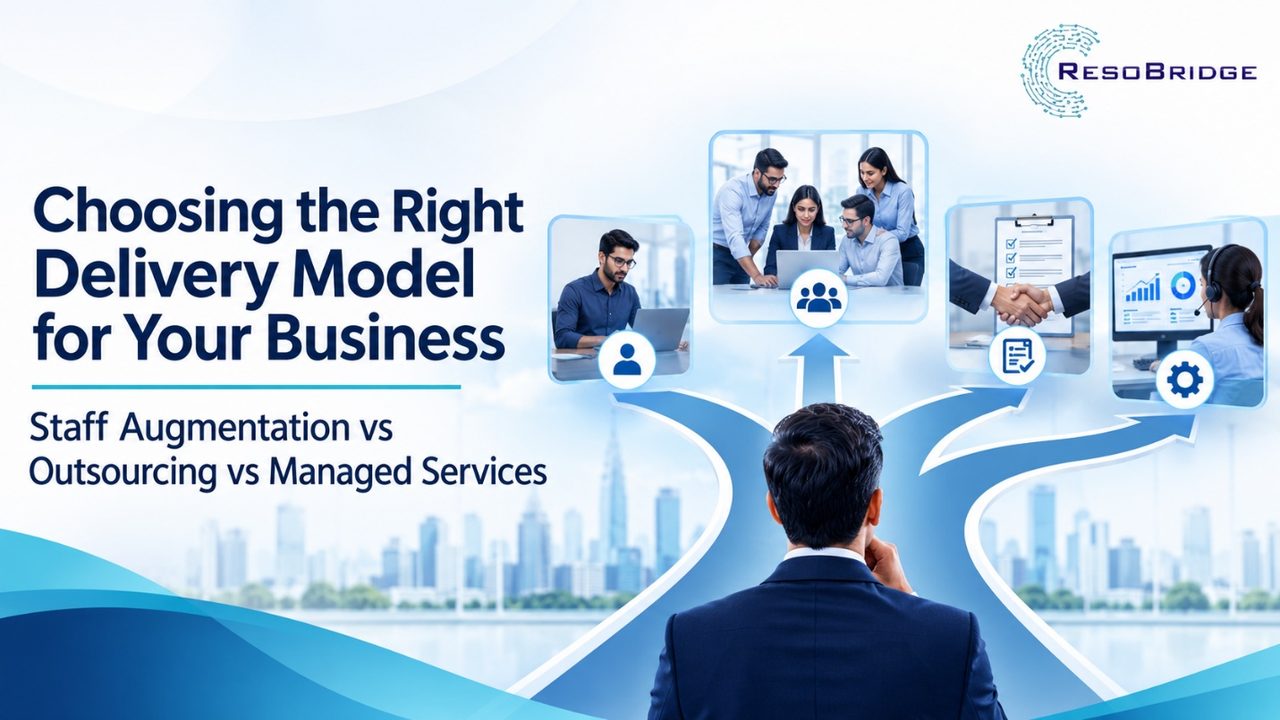
Most delivery model decisions go wrong before anyone signs anything. Leaders line up three quotes, pick the cheapest or the safest-looking one, and only later find out that nobody agreed who directs the work or who answers for the result. Staff augmentation looks cheaper than a managed service. A fixed-fee outsourcing bid looks safer than both. Then the project drifts.
This guide covers four options: full-time hiring, staff augmentation, project outsourcing and managed services. It leans on analytics and data work, where a wrong call costs more than usual, because what your team learns along the way is often worth more than the dashboard or model it ships. It also comes from a provider that delivers under all four, Resobridge, so the comparison reflects running each model rather than selling one of them.
Key takeaway: Pick the model by ownership first and price second. Ask who directs the work, who answers for the outcome, and who keeps the knowledge afterwards.
A delivery model is the arrangement that settles who directs the work, who answers for the result and how you pay. Four options cover most B2B situations, and each shifts a different amount of control and risk between your team and an outside provider. Resobridge works under all four, so the notes below show where it fits in each.
The vocabulary adds to the confusion. "Outsourcing" is often used as an umbrella for everything above. RSM draws a useful line: outsourcing describes where the work is performed, while managed services define how an outcome is delivered and governed. Staff augmentation, by contrast, adds individuals to a process the company still leads.
The core difference is accountability. With staff augmentation you keep it: your team directs the work and owns the result. With project outsourcing, the vendor owns a defined deliverable. With managed services, the vendor owns an ongoing outcome measured against service levels.
| Dimension | Full-time hire | Staff augmentation | Project outsourcing | Managed services |
|---|---|---|---|---|
| Who directs daily work | You | You | Vendor | Vendor |
| Who owns the outcome | You | You | Vendor (per scope) | Vendor (per SLA) |
| Typical pricing | Salary + overhead | Hourly or monthly rate per specialist | Fixed or capped project fee | Recurring subscription or retainer |
| Speed to start | Slowest | Fast | Moderate | Moderate to slow (transition) |
| Flexibility to change scope | High | High | Low (change orders) | Low to moderate |
| Where knowledge stays | Your company | Mostly your company, if you enforce handover | Largely the vendor | Largely the provider |
| Best for | Core, steady roles | Skill gaps, evolving scope | Defined projects | Permanent operations |
| Main risk | Slow hiring | Management load, knowledge walking out | Scope disputes, lock-in | Dependency, less change |
| How Resobridge supports it | Hiring support for analytics and data roles | Embedded analytics specialists | Fixed-scope project delivery | Ongoing managed analytics services |
In short: control and management effort rise together. The more of the work you want to steer, the more you should lean toward staff augmentation. The more you want to stop thinking about it, the more you should lean toward managed services.
Hiring conditions explain why more teams now look beyond full-time recruitment. ManpowerGroup's 2026 Talent Shortage Survey found AI skills to be the hardest to find globally for the first time, pushing traditional IT and data skills down to seventh place. That is a ranking shift, not proof that data talent has become easy to hire.
Analytics roles remain tight. In the Reveal 2026 IT Talent Survey, data analytics professionals were among the hardest positions to staff, and only 7% of respondents reported no hiring difficulties. Robert Half found that 64% of SMB tech leaders and 79% of large-enterprise tech leaders report a skills gap in their department.
Two practical consequences follow. First, speed to capability now matters as much as price. Second, a specialist you can bring in for a defined stretch often beats a drawn-out search for a permanent hire you may not need in a year. This is also why a partner that can offer more than one model is useful: the answer today may not be the answer six months from now.
Staff augmentation works when your team can steer the work but is short of people or a specific skill. Think of a data engineer to finish a pipeline migration, or a Power BI developer while your analysts focus on stakeholder requests. It fits when:
The risks are real. Augmented specialists need onboarding, and your management time is the hidden cost. If documentation is weak, their context leaves when the contract ends. Resource augmentation also performs only as well as the access, data definitions and priorities you give it. Resobridge's analytics staff augmentation is built around that last point: specialists arrive ready to work in your stack, and handover notes are part of the job rather than an afterthought.
When it is the wrong choice: if nobody on your side can direct the work, you are paying for hands with no head. Choose a project or managed model instead.
Project outsourcing suits work you can describe, price and accept. A market-sizing study, a one-time forecasting model or a dashboard rebuild with agreed metrics are typical examples. You trade control for predictability, and the weak point is ambiguity: every unclear requirement turns into a change order. Resobridge handles project work from scoping to delivery, and it tends to push for acceptance criteria early because that is where fixed-fee projects are won or lost.
Managed services fit recurring operations that need reliability more than creativity, such as scheduled reporting, data pipeline monitoring and platform upkeep. You get service levels and a steady fee. You give up day-to-day influence, and you should plan for the provider's processes to stay in place for a long time. Resobridge runs managed analytics services against agreed service levels, so the people who maintain your reporting are accountable for it.
Some roles are simply too close to your competitive edge, or too steady in demand, to rent. For those, hiring is still the right call. Resobridge can help with the search, but it will also tell you when a role should stay internal rather than be filled through a contract.
The Ownership Test is a short screen built on four questions. Answer them for how your organisation actually works today, not how you wish it worked.
| Your answers | Best-fit model | Why |
|---|---|---|
| Unclear scope, a lead available, knowledge must stay | Staff augmentation | You steer and keep what is learned |
| Clear criteria, no lead available, knowledge can sit outside | Project outsourcing | The vendor carries management |
| Permanent operation with definable service levels | Managed services | Reliability matters more than flexibility |
| Permanent, core to your edge, steady demand | Full-time hire | Long-term ownership pays off |
| Mixed answers | Hybrid | Different stages need different models |
This is a hypothetical composite, not a client story. A mid-sized B2B company wants a revenue forecasting dashboard. At first, finance and sales define "pipeline" differently, so the scope is fuzzy. The company brings in two augmented analysts to work inside its team through discovery. Once definitions settle and acceptance criteria exist, the build moves to a fixed-scope project. After launch, a small managed service handles refreshes and monitoring, while one internal analyst owns the business logic. Each model covers the stage where it is strongest.
That sequence is hard to pull off with three separate vendors, because every handoff loses some context. It is simpler when one provider can staff the discovery, build the project and run the service afterwards, which is the situation Resobridge is set up for.
Resobridge is an analytics consulting firm, and the delivery model question comes up in almost every engagement. Unlike a staffing agency that only places people, or a vendor that only sells fixed-scope projects, Resobridge works across the whole range. Clients can hire through it, bring in embedded specialists, hand over a defined project, or have an ongoing function run for them.
That range matters for a practical reason. The model that suits you at the start of an analytics programme is rarely the one that suits you a year in. With one partner across all four, a change of model is a change of contract rather than a change of vendor, and the people who already know your data don't have to be replaced.
What this looks like in practice:
If you are weighing options, a short scoping conversation built around the Ownership Test above is a sensible place to start. Talk to Resobridge about which model fits your next piece of analytics work.
No delivery model is best in general. The right one matches your scope clarity, management capacity and knowledge needs today. Run the four questions, choose the model they point to, and revisit the choice as the work matures. If you would like a second opinion on where you land, Resobridge is happy to talk it through.
Staff augmentation is a model where external specialists join your team temporarily and work under your management. The provider handles recruiting, contracts and payroll, while you assign tasks and own the results.
In staff augmentation, you direct the work. In project outsourcing, the vendor manages the people and delivers an agreed result. Augmentation gives you more control and flexibility. Outsourcing gives you more predictability when the scope is clear.
Managed services transfer ongoing operations to a provider, measured by service levels. Staff augmentation adds individuals to your team and keeps accountability with you.
Not always. Hourly rates are often higher than salary equivalents, but you avoid recruiting time, long-term commitments and idle capacity. It tends to be cost-effective for short, specialised needs and less so for permanent core roles.
Use it when you have a clear goal, a lead who can direct the work, and a temporary skill or capacity gap, such as a BI developer or data engineer for a defined phase.
Yes. A common pattern is augmentation during discovery, a fixed-scope project for the build, and a managed service for ongoing operations.
Resobridge offers all four: hiring support, staff augmentation, project outsourcing and managed services. It works with Power BI, Tableau, Qlik, SQL and Python, and has delivered under each model for multi-billion-dollar companies.
Yes. Because it delivers under every model, a client can start with embedded specialists during discovery, shift to a fixed-scope project for the build, and move to a managed service once the work is live, without bringing in a new provider at each
Planning a Power BI rollout, a business intelligence refresh or analytics staff augmentation? We are happy to look at it with you.
Talk to an Expert